
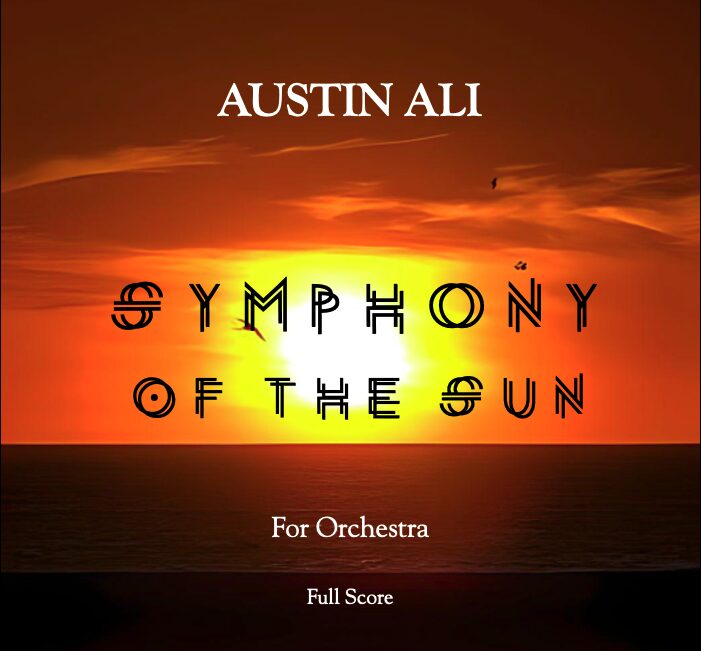
Symphony No. 1: Symphony of the Sun
For more information, read my UCLA PhD Dissertation, Music Composition in Dialogue with the Cosmos: Gustav Holst, Paul Hindemith, and Symphony of the Sun by Austin Ali
TOTALITY
“Totality” is the first movement of Symphony of the Sun, a deeply personal composition inspired by the once-in-a-lifetime total solar eclipse occurring over my childhood home of Dallas, Texas on April 8th, 2024.
In the music, I incorporated the image of the Moon swallowing the Sun whole by contrasting extreme dark and light. The composition begins with a spacious adagio painting the stellar landscape behind the celestial event, inspired by my first trip to the Mojave Desert. From the ethereal texture emerges a bouncy string ostinato, bringing the energy of a new day. From this daytime music, a soaring horn solo forewarns the coming eclipse, followed by a violent variation of this solo in the percussion, announcing the moment of totality. As day rapidly descends into night, a primal cry erupts from the winds and solo cello in the darkest moment. Just as quickly as the Moon’s shadow came over the Earth, the brilliance of the Sun’s corona highlights the sky, shining in a full orchestral tutti.
HARMONY OF THE SPHERES
“Harmony of the Spheres” depicts a revelation to the Earth during the eclipse. With the fiery solar corona in full view, the fate of the Earth becomes clear: the Sun will eventually envelop the Earth. Thus, the music juxtaposes the intense beauty of the Sun with its terrifying destructive power.
The composition features a prominent trumpet solo pitted against the whole orchestra, representing the individual in the face of the entire cosmos. The climax of the movement illustrates the impact of a coronal mass ejection from the Sun on the Earth, a reminder of the Sun’s ability to reach across the solar system and touch the Earth.
UNVEILING LIGHT
After the moon swallows our closest star, the Sun re-emerges, as if it had risen twice in one day. “Unveiling Light” explores the rebirth of the Sun, beginning in the darkness and ultimately revealing the brightest light.
I traveled back home to Texas while composing this movement to witness the eclipse. Therefore, the composition also reflects the journey home. The Earth, the Moon, the Sun, my hometown, and my loved ones all aligned during the sun’s spectacular show.
Musically, the main motifs include a rhythmic ostinato (an Austin-ato) driving the piece and a triumphant series of leaping melodies. The piece culminates in a fugue (referring to the Latin fuga, meaning “escape”), representing the escape of the Sun from its metaphorical death in the eclipse.
Piccolo
2 Flutes
2 Oboes
2 Clarinets in B-flat
Bass Clarinet
2 Bassoons
Contrabassoon
4 Horns in F
3 Trumpets in C* (Straight mute, cup mute, harmon mute)
*First Trumpet Doubles on Trumpet in B-flat in the second movement
2 Tenor Trombones (Straight mute, cup mute, harmon mute)
Bass Trombone (Straight mute, cup mute, harmon mute)
Tuba
Timpani (+Suspended Cymbal^)
3 Percussionists (suggested distribution:)
I.
Player 1: Suspended Cymbal, Tom, Crash Cymbal, Glockenspiel
Player 2: Vibraphone, Bass Drum 1, Taiko Drum (optional)
Player 3: Bass Drum 2, Brake Drum
II.
Player 1: Tam-tam, Bass Drum, Thundersheet*, Vibraphone*
Player 2: Brake Drum, Vibraphone*, Bass Drum, Whip, Chimes, Xylophone
Player 3: Anvil, Crotales, Shaker, Castanets, Thundersheet*, Crash Cymbal, Tam-tam
III.
Player 1: Glockenspiel, Whip, Tam-tam, 3 Toms, 2 Wine Glasses (B♭4, F5), Bass Drum
Player 2: Vibraphone, Xylophone
Player 3: Crotales (optionally substitute for Wine Glasses)
*Instrument shared between players
^Note: Susp. Cymbal for special effect on Timpani
Piano
Harp
Strings (at least one Contrabass with C-extension required)
Similar compositions
-
String Quartet No. 1: Chiaroscuro (2022)
$50.00 -
Groove, Meditation, and Fugue (2024)
$50.00 -
Cinematic Suite (2024)
Price range: $40.00 through $275.00 -
Blissful Nightmares (2014)
Price range: $50.00 through $300.00 -
High-Flyers (2023)
$30.00